
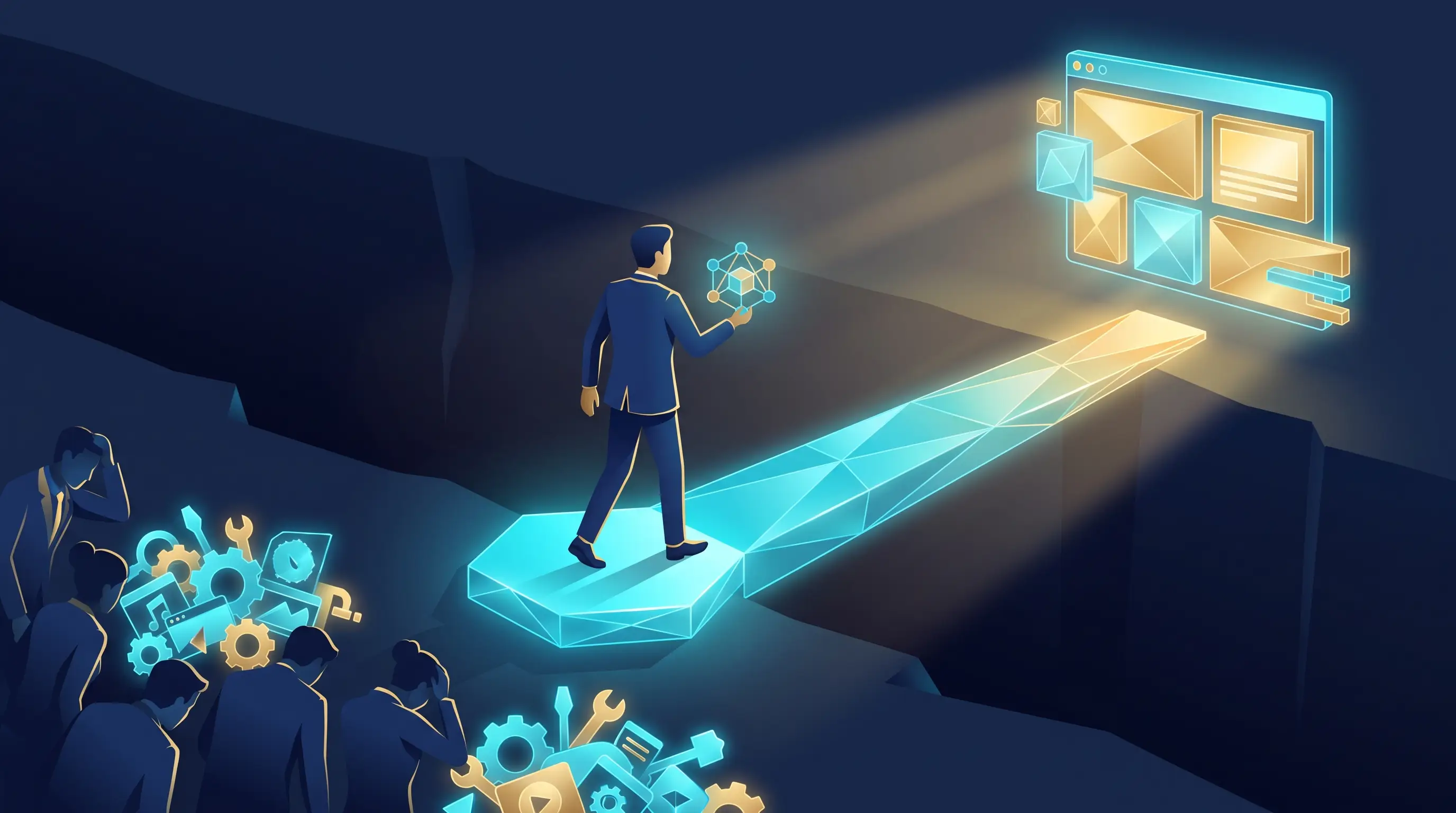
Everyone Bought AI. Almost Nobody Crossed the Gap.
By Paul Ruddy · July 31, 2026
Most companies have adopted AI. Very few have been transformed by it. The distance between those two things is where budgets quietly disappear, and it is far wider than almost anyone plans for.
Adoption is easy. Transformation is engineering.
Buying AI is a credit card and an afternoon. Every tool is available to everyone, which is why nearly every company can now say it uses AI. Transformation is a different thing entirely. It means the business actually runs differently, produces more, and can do things it could not do before. Getting there is not a purchase. It is engineering, and it is the part nobody sells you.
The front half of the bridge: digitize and connect
Before any agent can do useful work, the work itself has to exist in a form software can touch. For most small and mid-sized businesses, it does not. The real process lives in someone's head, on paper, or in a spreadsheet nobody else can read. The systems that hold the data do not talk to each other, so the same information gets keyed in three times and reconciled by hand.
So the first half of crossing the gap is unglamorous and essential: digitize the manual workflows, and connect the systems that never talked. An agent pointed at an undocumented, disconnected process does not transform it. It automates the confusion faster. Digitizing and connecting is the foundation everything else stands on.
The back half: architecture, DevOps, a skills layer, and orchestration
Once the work is digital and the systems are connected, the rest of the stack is what actually carries you across. Solution architecture, so the pieces fit. Full-stack build and integration ops, so capability reaches from one system to the next. CI/CD and DevOps, so it ships and stays reliable. A skills layer that captures your team's real knowledge, so the agents run your business the way your best people would. And orchestration, so the agents coordinate instead of firing in isolation.
Written out, that is a software company's worth of capability. Most SMBs were never set up to build it. Standing it up in house means new senior hires, new tooling, a solution architecture nobody on staff has done before, and a token bill that surprises everyone the first month.
Even the companies that can build it hit a wall
Large organizations can assemble this. But they run into a second problem money does not solve: someone has to orchestrate the agents. That is a leadership job, deciding what the agents should do, where they hand off, and what good looks like. And most leaders are still buried in the day to day. The shift from doing the work to orchestrating the agents that do the work is a monumental one, and it changes what a leadership role even is.
What crossing looks like when it is done for you
A multi-location service business we work with had bought the tools and gone nowhere. Once we digitized how a job actually moves from first call to final invoice, connected the systems that had been islands, and put orchestration on top, the same tools they already owned started to compound. The change was not a smarter model. It was the bridge finally being there to walk across.
This is what we build
Zyos Group builds and runs the bridge. We digitize the workflows, connect the systems, stand up the architecture and the DevOps beneath them, capture your team's knowledge as a skills layer, and orchestrate the agents. Delivered as a service and human-led, so you cross to transformation without having to become a software company.
operating-model FAQ
Questions operators ask.
Answers to common questions on this topic.
What is the gap between AI adoption and transformation?
Adoption is buying and using AI tools. Transformation is the business actually running differently and producing more because of them. The gap between the two is engineering work: digitizing manual workflows, connecting systems, building the architecture and DevOps, capturing team knowledge as a skills layer, and orchestrating the agents. Most companies buy the tools and never build that, so they never cross.
Why can most small businesses not cross it alone?
Crossing takes a software company's worth of capability: solution architecture, full-stack build, integration ops, CI/CD and DevOps, a skills layer, and agent orchestration. Standing that up in house means senior hires, new tooling, and running costs most SMBs were never set up for. It is usually faster and cheaper to have it built and run for you.
What does digitizing workflows and connecting systems mean?
Digitizing workflows means turning processes that live in someone's head, on paper, or in a spreadsheet into a defined, software-readable flow. Connecting systems means wiring the tools that hold your data so they share one source of truth instead of being reconciled by hand. Both come before agents, because an agent on an undocumented, disconnected process just automates the confusion.
One vendor. Operations, technology, data, software.
Start with a measurement.
The Opportunity Engine scores your operating layer across five dimensions in about fifteen minutes, then names your biggest gap. No sales call to get the report.